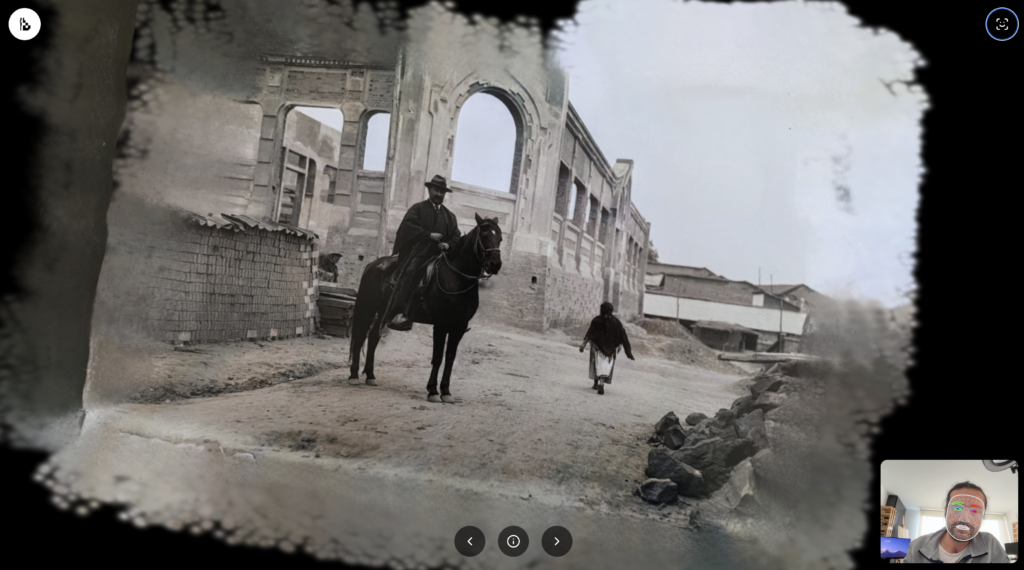
There is one AI development that we find truly magical: Gaussian Splatting.
For those unfamiliar with it, Gaussian Splatting originally emerged as a technique for reconstructing 3D environments from a collection of photographs. Think of photogrammetry, but with a magical twist. Instead of reconstructing a scene with traditional meshes, the algorithm represents the world as millions of tiny Gaussian “splats” distributed throughout 3D space. The result is remarkably realistic, preserving subtle lighting effects, reflections, and color variations that make scenes feel almost tangible.
It’s an astonishing technique, and it has evolved incredibly fast. Today, it’s even possible to generate convincing Gaussian splats from a single image, creating an impressive illusion of depth from what was originally just a flat photograph.
When we started building ArchiHUB, one of our strongest visual references was the way memory is explored in the film After Yang. Go check it out if you haven’t. We have always imagined ArchiHUB as a vehicle that could eventually make that kind of experience possible. We’re not there yet, but today we’re a little closer.
This experiment is one small step in that direction.
What can we already do with an image in ArchiHUB
At its core, ArchiHUB is powered by what we affectionately call the “boring” part of the system: a solid administrative interface that allows users to organize collections according to their own rules and workflows.
The exciting part begins once those images enter the processing pipeline. This is where ArchiHUB’s real strength starts to shine.
Every image can be automatically analyzed. We can generate detailed descriptions, identify objects and people, assign semantic labels, and even segment individual elements within an image. In the end, all of this becomes something incredibly powerful: text.
And text is searchable.
That means we can take a large photo collection, automatically enrich every image with descriptions, tags, and semantic metadata, and instantly make the entire archive searchable using natural language. Instead of manually organizing thousands of photographs, the archive gradually organizes itself into something that can be explored in entirely new ways.
Now comes the fun part
Once all of this information exists, we’re no longer limited to displaying images as thumbnails in a traditional gallery. We can begin experimenting with entirely new ways of navigating visual memory.
And that’s exactly what today’s experiment is about.