Developed for the Qwen Hackathon, Scenius leverages a specialized architecture of models from the Qwen ecosystem to orchestrate its creative pipeline. Our core goal was to build an application that enhances the traditional workflow of writing and generating storyboards, transforming a simple concept and a few parameters into a structured narrative. Above all, the main driver of our application is keeping the human in the loop: at every single step, the user retains full control to modify the AI’s output or bypass it completely.
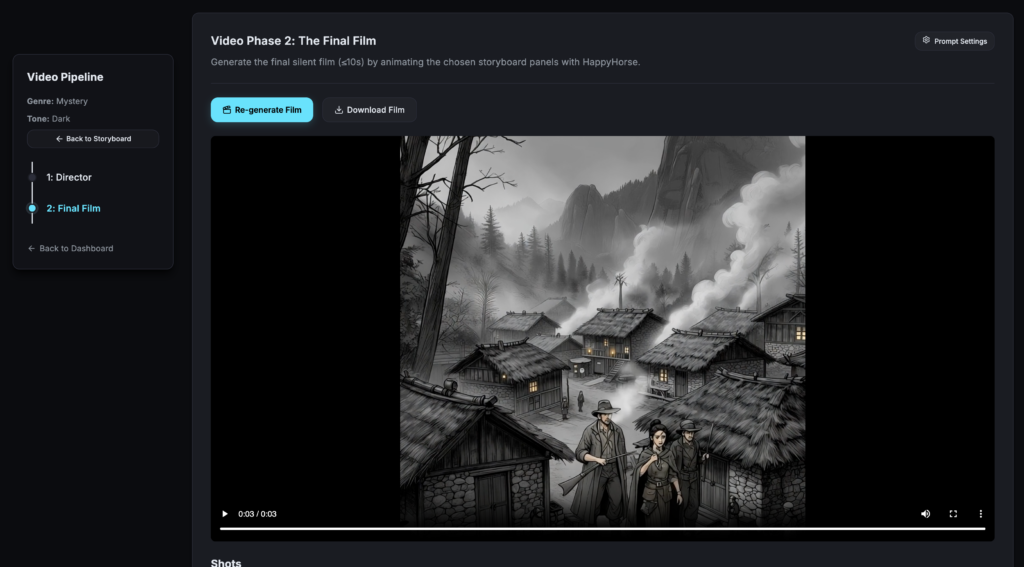
happyhorse-1.0-i2v (Video Animation): Drives the image-to-video pipeline, bringing the static panels to life by animating them into dynamic 3-to-15-second cinematic clips for the final micro-film.
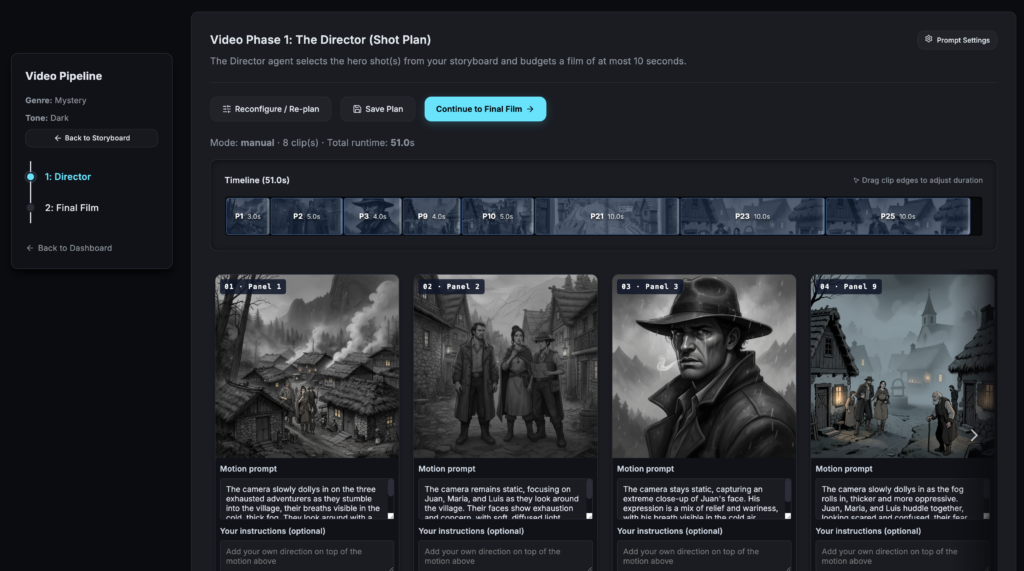
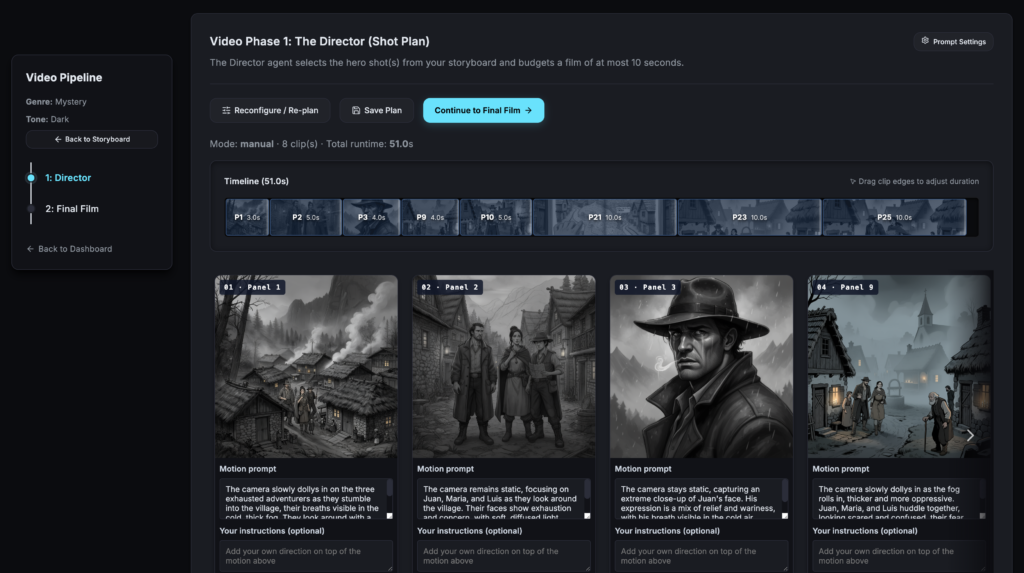
qwen-max (Text Engine): The main intellectual core. It drives the multi-agent system to write scripts, optimize prompts, and act as the “Director” agent that plans camera movements and scene blocking.
wan2.7-image-pro (Image Generation): Handles text-to-image and image-to-image variations, allowing users to alter specific storyboard frames using their own visual references and targeted prompts.
The script pipeline
The scriptwriting pipeline is heavily inspired by the 2022 paper “Co-Writing Screenplays and Theatre Scripts with Language Models: An Evaluation by Industry Professionals”. While not identical, our workflow adopts a similar stepped progression for script development. The process initiates from a foundational idea and continuously iterates through manual user input or AI assistance.
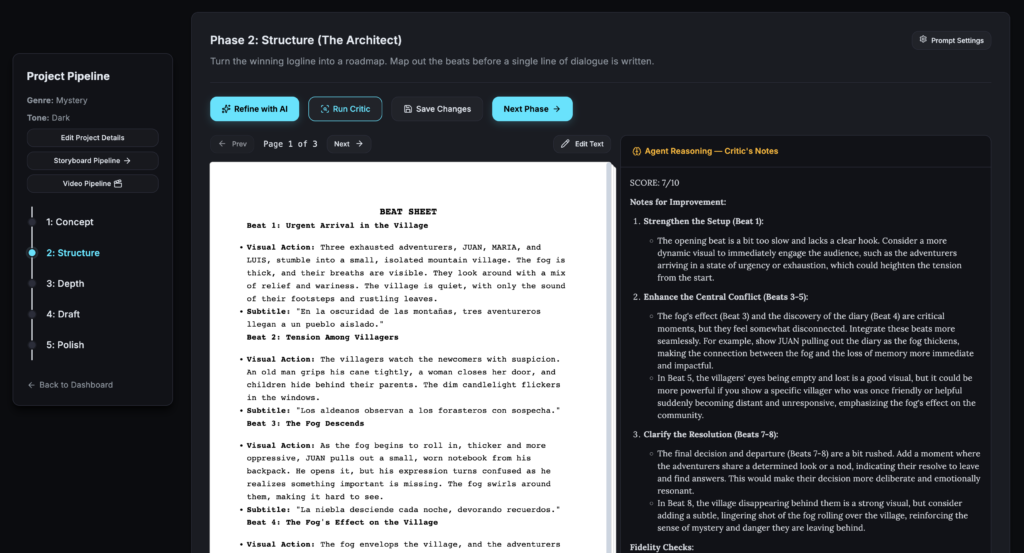
We also integrated a dedicated “critic” agent that analyzes the draft to highlight narrative gaps or areas of improvement, leaving the final creative decision entirely to the writer. Although the AI assistant remains completely optional, our testing consistently showed that integrating human guidance at early stages dramatically improves the quality of the final output; proving that collaboration yields better results, even for non-professional writers.
Concept (The Brainstormer): Establishes the opening narrative segment, outlining the setting, characters, and inciting incident. It is strictly constrained from resolving the plot or escalating the core conflict prematurely.
Structure (The Architect): Translates the foundational concept into a structured 6-to-12-scene beat sheet, enforcing strict factual fidelity to the original parameters (such as character ages and baseline constraints).
Depth (The Profiler): Generates comprehensive character bibles and defines the narrator’s tonal voice. Because Scenius produces silent films, this agent focuses heavily on physical tells, visual motifs, and external, actionable goals.
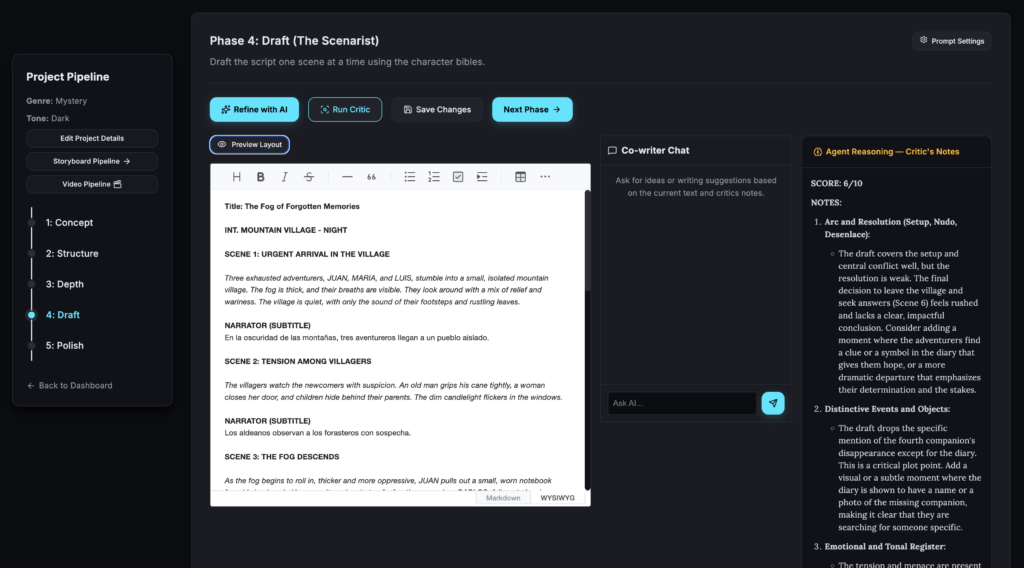
Draft (The Scenarist): Converts the beat sheet and character bibles into a complete script. It strictly enforces a “no spoken dialogue” constraint, formatting the output exclusively around visual actions and contextual narrator subtitles.
Polish (The Script Doctor): Refines the final draft by enhancing subtext, eliminating boilerplate “AI-speak,” and tightening the overall pacing to ensure the story fits a compressed 1-minute runtime.
The storyboard pipeline
The storyboard generation pipeline is engineered to ensure visual continuity and technical precision, combining structural LLM logic with a tailored image-to-image workflow. It executes across four specialized phases:
Shot List (The Master Cinematographer): Converts the polished script into a highly technical, production-ready shot list, detailing specific camera movements, framing, lighting conditions, and precise action blocking for every single frame.
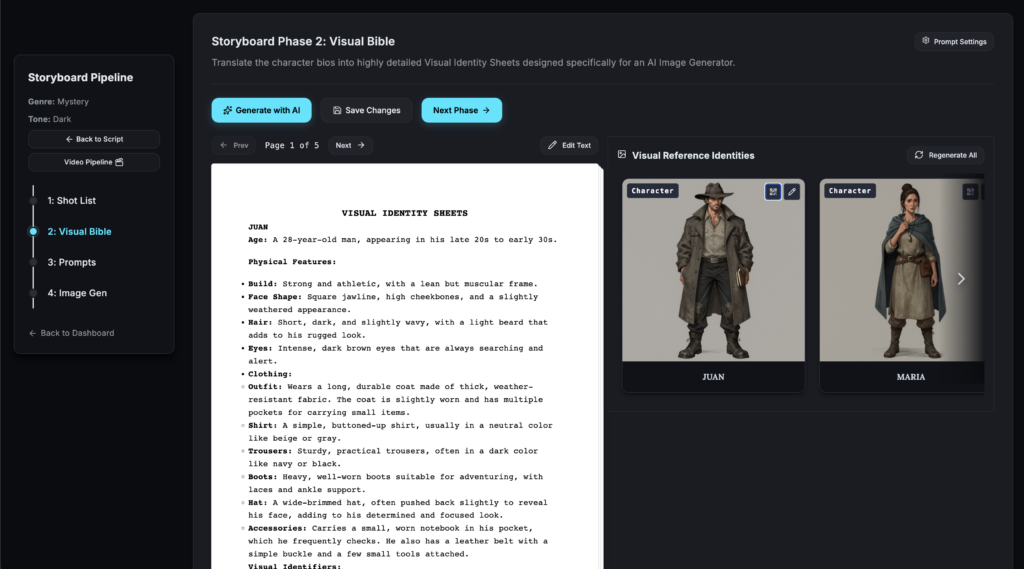
Visual Bible (The Concept Artist): Establishes the visual identity for characters and environments. It ingests the text descriptions from the Profiler stage (which the writer can freely modify or craft from scratch) and generates a definitive character reference image. This phase strictly enforces an “Age-Lock Rule” to ensure characters maintain structural and age consistency across subsequent generations.
Prompts (The Prompt Architect): Translates the technical shot list into machine-optimized prompts for the image generation engine. Crucially, this agent is explicitly restricted from describing character physics or features in the text prompt, relying entirely on the visual anchors established in the Visual Bible.
Image Generation (The Pipeline Engine): Executes the underlying API calls. It automatically injects the generated character reference images alongside a global visual style suffix (e.g., “Pencil Sketch” or “Noir Photography”), ensuring the entire automated storyboard maintains strict visual and stylistic coherence.
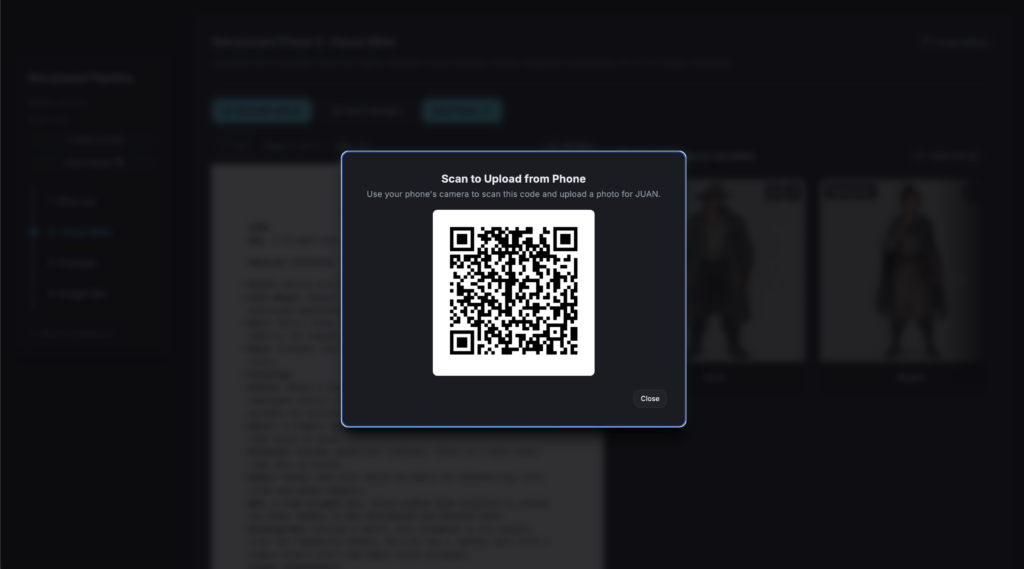
Late in the development process, our testing revealed a crucial insight: the most effective way to guide the visual AI generation was through image-to-image conditioning rather than text alone. To streamline this for the creator, we implemented an intuitive QR-code-based upload system.
At any visual generation stage (including the final storyboard or individual panel regeneration) the user can scan a QR code with their phone to instantly upload a photo of a hand-drawn sketch, a specific location, a reference person, or a mood board concept. This feature is powerful across the app but is absolutely critical during the Visual Bible phase, allowing users to lock in character features and environmental concepts using their own tangible references as the visual foundation.
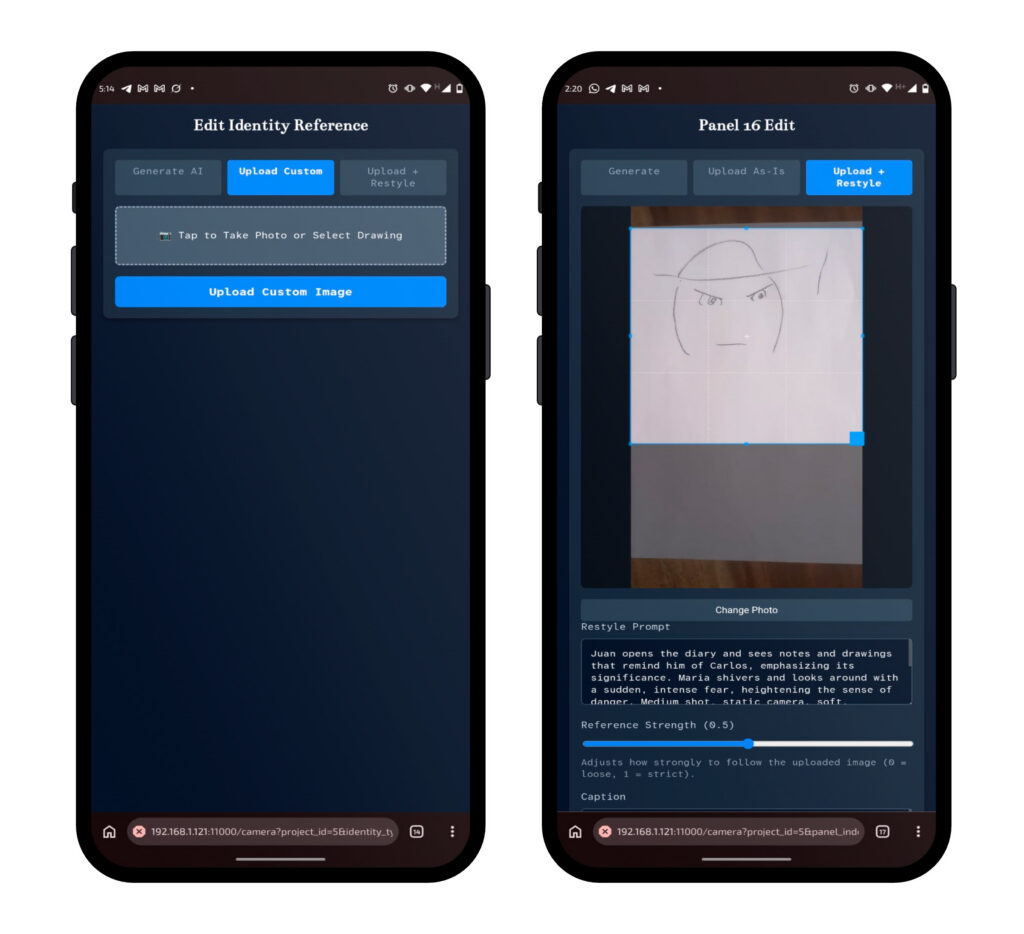
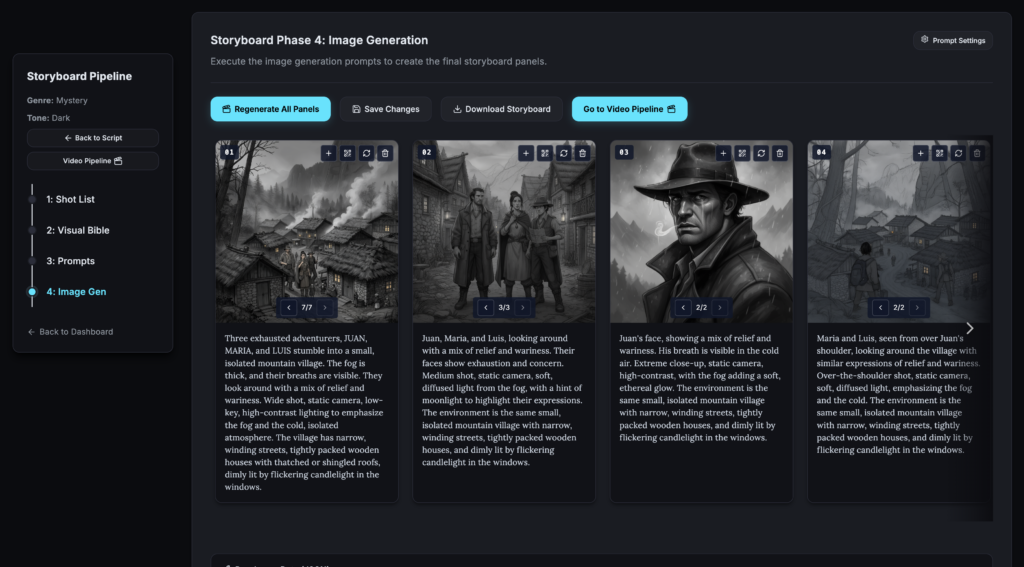
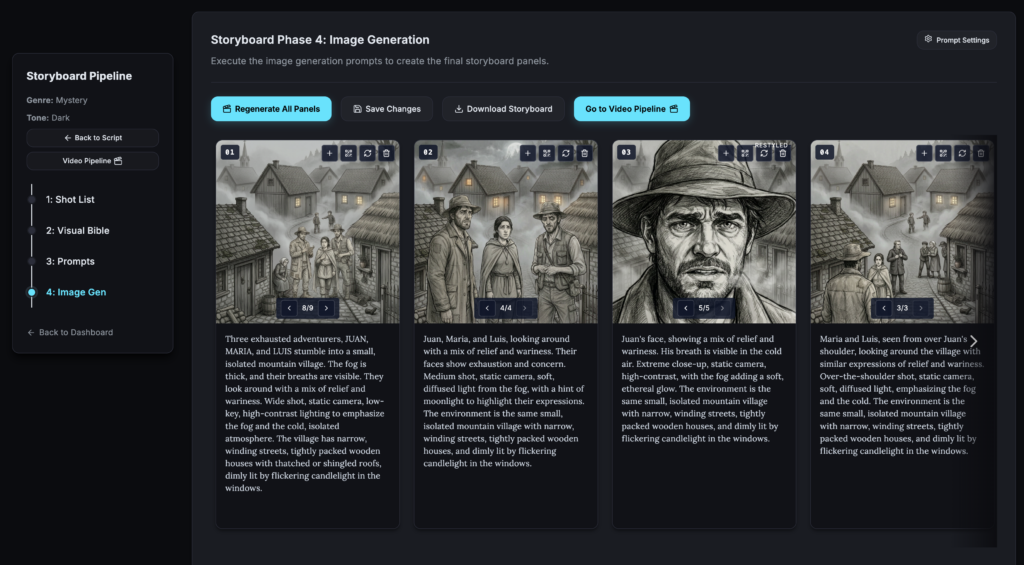
The final phase of the storyboard pipeline renders the visual output based on the generated shot list. To ensure maximum flexibility, the system presents the writer with a set of fully editable prompts for each shot, allowing for precise, frame-by-frame adjustments. While mastering the underlying image generation model is beneficial, the ability to upload a reference sketch remains the system’s most critical feature. By allowing the user’s hand-drawn input to guide the model’s output, we transform the platform from a black-box generator into a true collaborative tool, ensuring the final visual result is faithful to the creator’s unique vision.
The video pipeline
The final phase of the application focuses on motion and sequencing. Once the storyboard images are rendered, the creator has one final point of intervention before sending the panels to the animation engine. In this stage, the user can selectively choose which frames to animate and precisely define the duration of each shot.
To accommodate different creative workflows, this sequencing process can be entirely automated by a Director Agent or meticulously curated by hand. Once the timeline is finalized, the system triggers the video pipeline to render the final micro-film.
The End
Building Scenius yielded critical insights into AI-assisted storytelling. The most significant takeaway is that attempting to fully automate creative problem-solving by excluding the human element consistently produces shallow, generic results. True creative resonance requires intent, nuance, and judgment.
Instead, designing systems that empower, accelerate, and amplify human discretion dramatically improves narrative and visual output. By keeping the creator in the loop (and allowing custom system prompts to be tailored for individual projects) Scenius ensures that AI serves as a flexible multiplier for human creativity rather than a replacement.