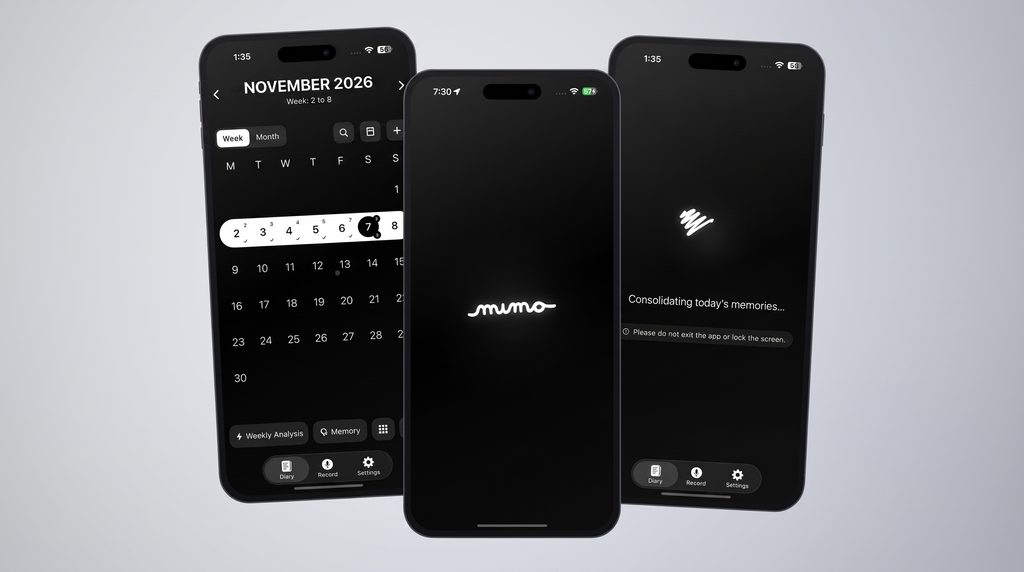
We have always dreamed of an assistant to whom we could simply dump everything running through our heads, leaving it to organize the notes, spot connections between ideas, remind us of pending tasks, and track our projects.
Something that would periodically compile all that information and deliver a kind of personal newsletter: “Hey! Here’s what crossed your mind this week. I spotted a few connections to topics we discussed last month. Here are the tasks you have lined up for next week, and here’s the latest progress on your projects.”
A sort of external memory that doesn’t just remember what I think, but helps me understand how things connect and what I need to take care of next.
At its core, mimo is a simplified version of ArchiHUB. Built exclusively for this purpose and, above all, designed to run models directly on the phone.
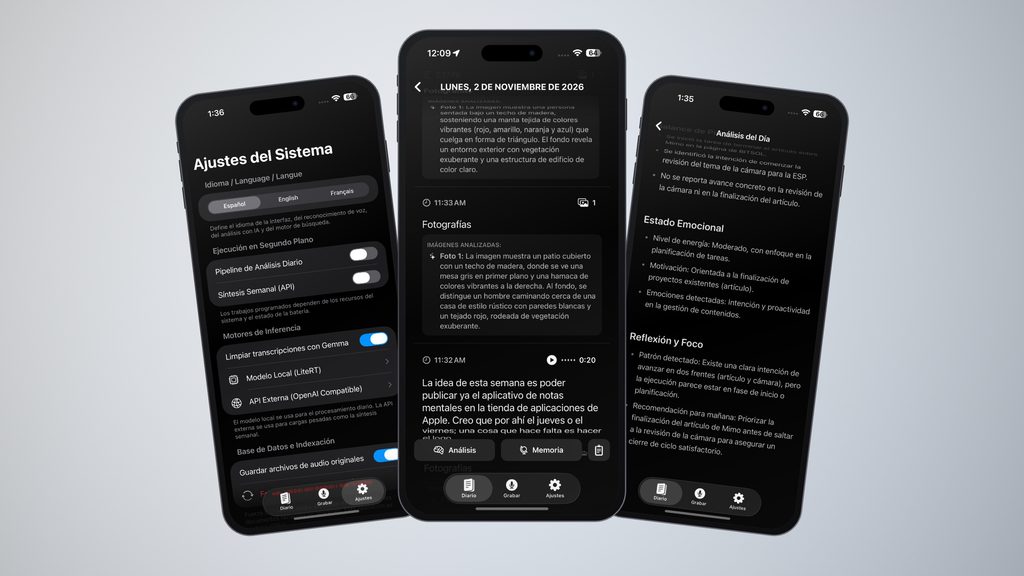
After every capture in mimo, a lightweight local agent analyzes the content, identifies potential tasks, and updates the to-do lists. It also tracks ongoing projects and their progress, fed by the various notes you accumulate over time.
The agent can explore that memory to discover connections between ideas, retrieve forgotten internal dialogues, and analyze how specific themes evolve. At the end of each day, it can generate an analysis of everything recorded and surface recommendations based on your other notes, projects, and tasks. You can also request these reviews on demand or ask directly about a specific project and its status.
This is the first version of mimo, with all core capture, processing, indexing, and retrieval capabilities already in place. The next step is exploring two lines of development:
The first is memory portability: allowing every installation of mimo to export its full contents; both to create backups and to ensure users retain total control over their data, ready to move it whenever they need to.
The second is exploring new ways to navigate and discover that memory. We don’t want mimo to be just another search engine we turn to only when we need to find something. We want to experiment with richer, more intuitive ways to explore our own thoughts: surfacing unexpected connections, visualizing the lifecycle of an idea, tracing a project’s history, spotting recurring patterns, and more.
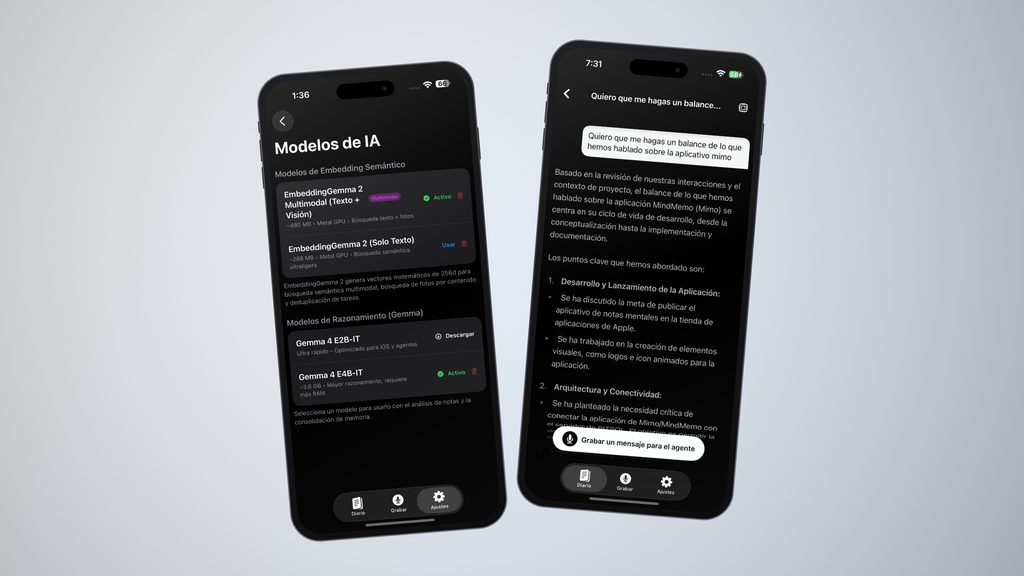
With today’s advancements, a task like this is practically tailor-made for a GPT. You could simply feed it all your voice note transcripts and ask it to extract tasks, organize thoughts, and synthesize the digest. But that was precisely what we wanted to avoid. If we were going to store our thoughts, ideas, ramblings, and introspections there, we didn’t want any of it leaving the phone. We wanted our external memory to also be a private space where our thoughts could exist without ever having to turn into data in the cloud.